Check out other Steel City Creative Services! Steel City Tap Co | Presto Embroidery

The Complete Guide to Pad Printing: Process, Capabilities, and Industry Applications

Brad Luger

• 

Posted on March 29 2026

If your product has a curved surface, a recessed area, or an irregular shape, standard printing methods will fall short. Pad printing was engineered specifically for these challenges. It is the commercial printing solution that puts crisp, durable graphics on objects that other processes simply cannot handle.

At Classic Printing & Signs, we use pad printing every day to help businesses brand promotional items, mark industrial components, and decorate consumer products with precision and consistency. This guide breaks down exactly how the pad printing process works, what it is capable of, and which industries depend on it most.

What Is Pad Printing?

Pad printing is an indirect offset printing process. The term "indirect" means the ink is never applied straight from the source to the final surface. Instead, it makes a stop along the way on a soft silicone pad that picks up the image and then transfers it to the object.

This seemingly simple detour is what makes the entire process so powerful. Because the silicone pad is flexible and compressible, it can conform to virtually any surface geometry. Flat, curved, concave, convex, textured, or deeply recessed surfaces are all fair game for the pad printing process.

How the Pad Printing Process

Works

Understanding the mechanics of pad printing helps clarify why it outperforms other methods on complex surfaces. The process follows a repeatable, four-step cycle.


Step 1: The Etched Plate (Cliche)

The image to be printed is etched into a flat metal or polymer plate called a cliche. The etched area holds ink in the recessed cells that form the design. The depth and precision of this etching directly determine how much detail and how fine a line the final print can reproduce.

Step 2: Ink Flooding and Doctoring

An ink cup or doctor blade floods the cliche with ink and then sweeps across it, removing all excess. This leaves ink only in the etched recesses of the design. The consistency of this step is what gives pad printing its renowned repeatability across large production runs.

Step 3: Pad Pickup

The silicone pad is pressed down onto the inked cliche. As it makes contact and lifts away, it picks up the ink image. A thin layer of solvent evaporates from the surface of the ink during this brief moment, making the ink slightly tacky. This tackiness is what allows the ink to transfer cleanly to the next surface rather than staying on the pad.

Step 4: Transfer and Print

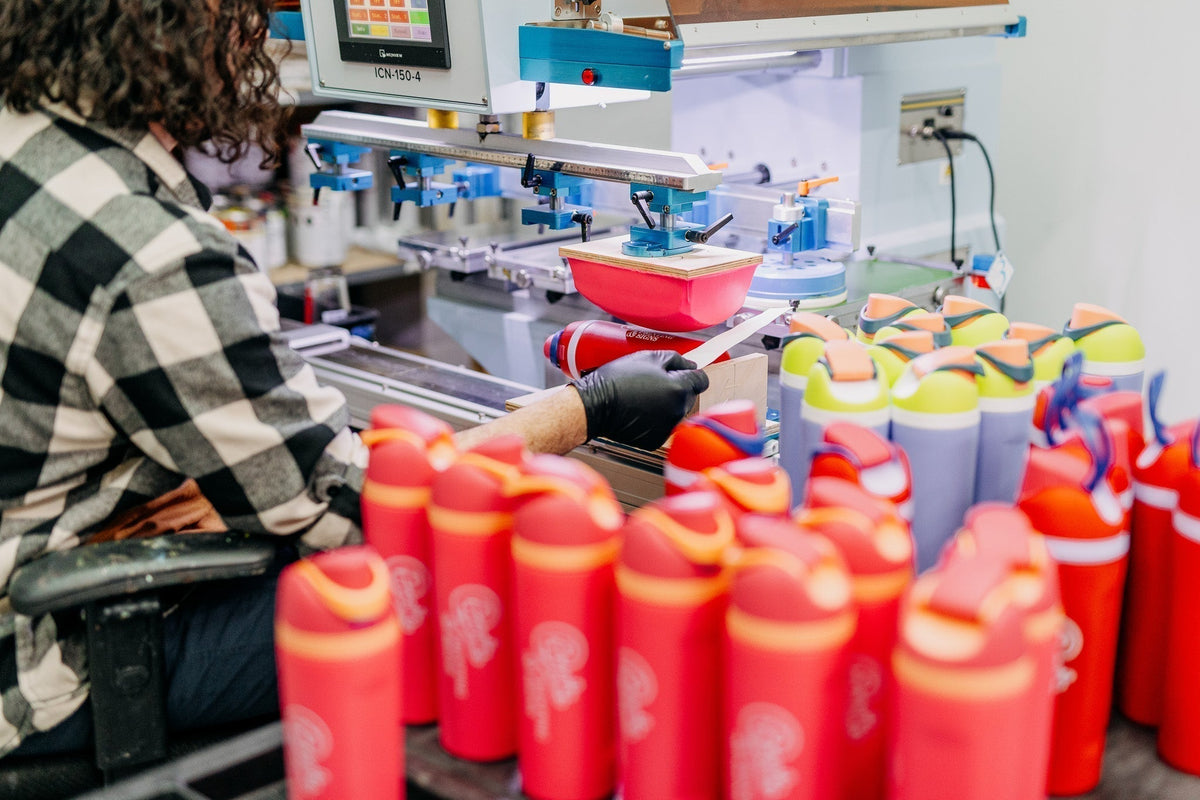
The pad is moved to the substrate and pressed against it. The tacky ink releases from the pad and bonds to the product surface. Because the silicone deforms as it compresses, it makes even contact across curved and irregular surfaces without stretching or distorting the image. The result is a clean, sharp print on virtually any shape.

Key Technical Capabilities of Pad Printing

The pad printing process is not just about handling odd shapes. It brings a strong set of technical advantages to the table for any B2B printing application.

Printing on Complex Surfaces

This is the defining capability of pad printing. The process handles surfaces that would be impossible or impractical with screen printing, digital printing, or flexography. Spheres, cylinders, cones, ergonomic grip shapes, recessed button areas, and contoured panels are all routinely pad printed at commercial scale.

Fine Detail and High Resolution

Pad printing can reproduce extremely fine lines, small text as small as 4 points, and intricate artwork with excellent clarity. For applications where brand integrity and legibility are non-negotiable, such as medical device markings or instrument dials, this level of precision is essential.

Multi-Color Registration

Modern pad printing equipment supports multi-color jobs with tight registration tolerances. Each color is applied in a separate pass, and automated machines maintain alignment even on curved surfaces. Full-color logos and detailed graphics are achievable with the right setup.

Broad Material Compatibility

Pad printing adheres to a wide range of substrates including plastics (ABS, polycarbonate, polyethylene), metals (aluminum, steel, anodized surfaces), glass and ceramics, rubber and silicone, and leather and coated wood. Specialty ink formulations are available for each material type, ensuring strong adhesion and long-term durability.

Cost-Effective for Short to Medium Production Runs

Setup costs for pad printing are relatively low compared to many industrial decorating methods. This makes it an economical commercial printing solution for runs ranging from a few hundred units to tens of thousands, without requiring prohibitively large minimum orders.

Consistent Repeatability at Scale

Automated pad printing machines deliver the same image quality from the first piece to the last. Color fidelity and registration remain stable across long production runs, which is critical for branded products and regulated industries where consistency is a quality requirement.

Industries That Rely on Pad Printing

The combination of geometric flexibility, fine detail reproduction, and broad material compatibility has made pad printing the preferred commercial printing solution across a diverse range of industries.

Promotional Products

Pens, keychains, lighters, USB drives, stress balls, drinkware, and golf balls are staples of the promotional products industry, and most of them carry pad-printed branding. The ability to print on rounded and irregularly shaped surfaces makes pad printing the default method for this market. A logo that wraps around a pen barrel or sits on the curved cap of a bottle is almost certainly the result of the pad printing process.

We have had the pleasure of producing pad-printed drinkware for a range of clients, including the team at Steel City Tap Co. whose branded bottles are a great example of the kind of sharp, durable imprints pad printing delivers on curved surfaces.

Medical and Healthcare Devices

Medical equipment demands printing that is precise, durable, and compliant with strict regulatory standards. Syringes, pill bottles, surgical instruments, diagnostic devices, and wearable health monitors are all candidates for pad printing. Biocompatible ink formulations are available that withstand sterilization processes including autoclaving and chemical disinfection.

Consumer Electronics

Keyboards, remote controls, computer mice, game controllers, circuit boards, and electronic housings all frequently carry pad-printed function indicators, labels, and brand logos. The process handles the hard plastics and metals common in electronics with ease, and the fine detail capability ensures that small icons and text remain legible over years of use.

Automotive Components

From dashboard controls and gear shift knobs to instrument panels, exterior badges, and interior trim, pad printing is used throughout the automotive manufacturing process. It produces crisp, wear-resistant markings that hold up under daily use, temperature cycling, UV exposure, and contact with cleaning products.

Sporting Goods

Golf balls, footballs, tennis rackets, fishing lures, and helmets routinely carry pad-printed logos and identification marks. The technique excels at printing on the spherical and curved surfaces of sports products that other printing methods cannot reach, making it the standard decorating solution across the sporting goods manufacturing industry.

Toys and Games

Board game pieces, action figures, toy vehicles, and puzzle components are often decorated using pad printing. The process provides the fine detail and vibrant color needed to bring small parts to life.

Industrial Tools and Instrumentation

Measurement tools, hand tools, machine components, and instrumentation dials all benefit from pad printing ability to deposit durable, legible ink onto metallic and non-porous surfaces. Printed graduations, warnings, part numbers, and safety markings remain readable through years of heavy industrial use.

Cosmetics and Personal Care Packaging

Lipstick tubes, perfume bottles, compact cases, and other cosmetic packaging are frequently decorated with pad printing to achieve the high-resolution, elegant graphics demanded by premium and luxury brands.

Why Businesses Choose Pad Printing Over Other Methods

When evaluating commercial printing solutions for a product with complex geometry, pad printing consistently wins out over alternatives. Screen printing requires a flat or cylindrical surface and cannot handle deeply recessed or compound-curved areas. Digital direct printing struggles with surfaces that are not relatively flat. Laser engraving removes material rather than depositing it. Pad printing sidesteps all of these limitations.

Pad printing inks are also formulated to bond chemically with the substrate, not just sit on top of it. This creates markings that resist chipping, peeling, scratching, and fading far better than surface-level adhesive methods like labels or decals.

Ready to Put Pad Printing to Work for Your Brand?

At Classic Printing & Signs, we combine state-of-the-art pad printing equipment with deep technical expertise to deliver results for B2B clients across every industry we serve. Our team works closely with you to select the right ink system, pad geometry, and production parameters for your specific substrate and design.

Whether you need a single-color imprint on a promotional giveaway or a multi-color logo on a precision-engineered component, we have the experience and equipment to get it done right, on time, and at a competitive price.

Contact Classic Printing & Signs today to discuss your project and request a custom quote. Let us show you what the pad printing process can do for your products.